



Apr
For the last nine months, I’ve been studying, researching and reproducing some of the paintings of Caravaggio, which then formed a painting course on this subject. My painting course started in October last year but was then extended due to the scale of the work.


In April, I travelled to Rome to see Caravaggio’s works that are permanently housed there – at Galleria Borghese, Cappella Contarelli, and Gallerie Nazionali Barberini Corsini. My trip also coincided with the unique retrospective exhibition of 24 of Caravaggio’s masterpieces at Gallerie Nazionali.
Not since 1951, when the Palazzo Reale in Milan inaugurated the first exhibition in history dedicated to Caravaggio, have so many of his works been exhibited together in one space. Caravaggio 2025 organises 24 of his paintings between four rooms and brings you through the evolution of his work, from his arrival in Rome in 1595 until his death in 1610 – a short fifteen-year career but one whose influence has had a profound impact on art in the centuries that followed.

My own course was structured around the three major periods of Caravaggio’s career: early, middle and late, focusing on the evolution of his style and his changing approaches to technique. One of the paintings we examined and reproduced was on display at this exhibition: David with the Head of Goliath (late period, c.1609-10) and another I saw in Galleria Borghese: Boy with a Basket of Fruit (early period, c.1593-95). The middle period painting we studied is housed in the National Gallery in London and wasn’t loaned to this exhibition: Supper at Emmaus (middle period, c.1601).
To see all of these paintings together in one space, in one experience, was magical. It has such a bigger impact to see so much of the work together, simultaneously, as opposed to seeing one or two paintings here and there in different museums. It really helps you to get a better sense of the evolution of the work. Despite having known so much about Caravaggio, his oeuvre, his working methods, the development of his style and technique, it’s a totally different experience seeing them in real life. That being said, I was very pleased to see that the research (through books and the internet) and reproductions that I had done were very accurate. Certainly, there are some deeper elements to the paintings that I noticed from seeing them up close and which would alter some small aspects of my master copy painting in the future. But by and large, what I saw and learned matched what I had done myself.
The gallery below is just a snapshot of some of the paintings that were exhibited.


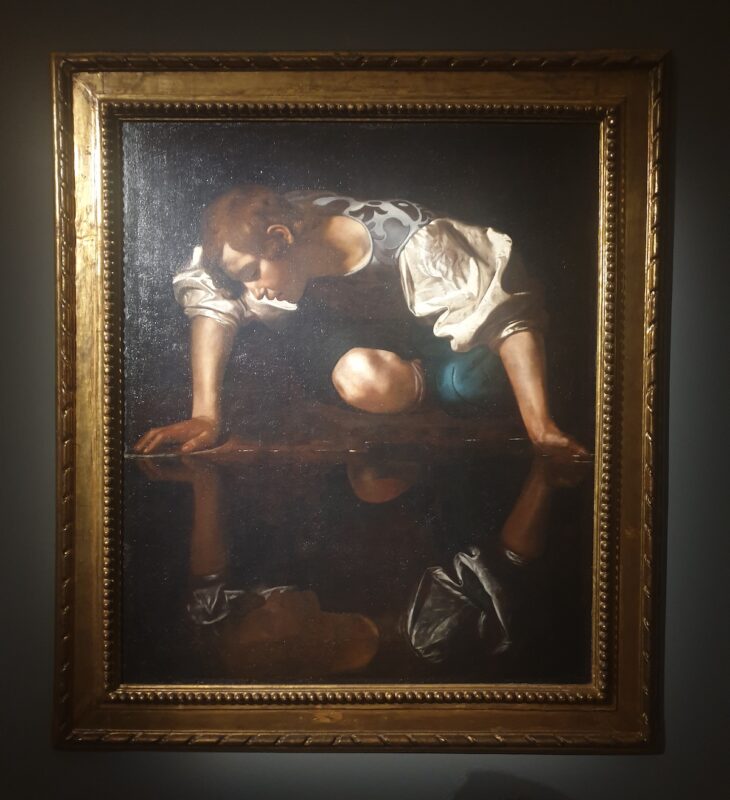


Caravaggio 2025 displays paintings from museums around the world and also from private collections that had never been displayed to the public, for example, Portrait of Maffeo Barberini, the Ecce Homo, and the first version of the Conversion of Saul for the Cappella Cesari.
This exhibition runs until 6th July 2025 and is a once-in-a-lifetime opportunity to see all of these paintings by Caravaggio in one show. Fantastic experience! For details, visit: https://caravaggio2025.barberinicorsini.org/en/
